Distributional Estimation of 3D Object Orientation
Abstract
The canonical orientation of a 3D object is often not unique, yet inherently ambiguous – symmetric objects, for instance, admit multiple equally valid canonical frames that no single-output regressor can faithfully represent. Existing methods struggle to handle this ambiguity: they either predict a single orientation, enforce symmetry only under pre-defined group assumptions, or rely on costly test-time augmentation to make their predictions robust. We propose a distributional approach that models 3D object orientation as a distribution over SO(3), accommodating both finite and continuous groups without any group-specific architectural bias. To this end, we develop an SO(3)-equivariant framework in which a truncated Wigner-D expansion encodes multiple valid orientations as a continuous, multi-modal distribution. On the ShapeNet benchmark, our method surpasses the prior state of the art across all categories under single-pass inference. Furthermore, even without test-time rotation augmentation, it matches the accuracy of a 50-vote ensemble baseline to within 0.5 percentage points at roughly 12× lower latency, demonstrating that explicit distributional modeling is both accurate and efficient.
Method
A Vector Neurons backbone and an e3nn spectral head map a point cloud to the Wigner-D coefficients of a density over SO(3). Both parts are SO(3)-equivariant by construction, so rotating the input rotates the predicted density, and inference needs no rotation augmentation. The modes of the density are the valid orientations. The mathematics behind each step is collected in Theory below.
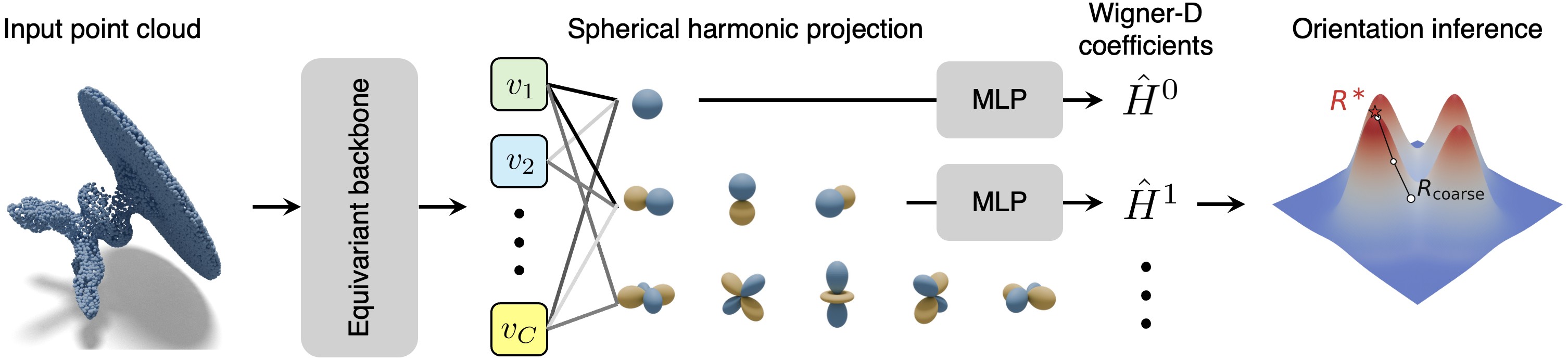
- Symmetry labels from geometry. A beam search over rotation axes assigns each training shape a cyclic or dihedral group, or none.
- Orbit target. One delta per valid orientation, smoothed with a heat kernel on SO(3) and written as Wigner-D coefficients.
- Prediction and inference. The network predicts the coefficients in one forward pass; a grid search with Newton–Raphson refinement finds the highest mode.
Interactive demo
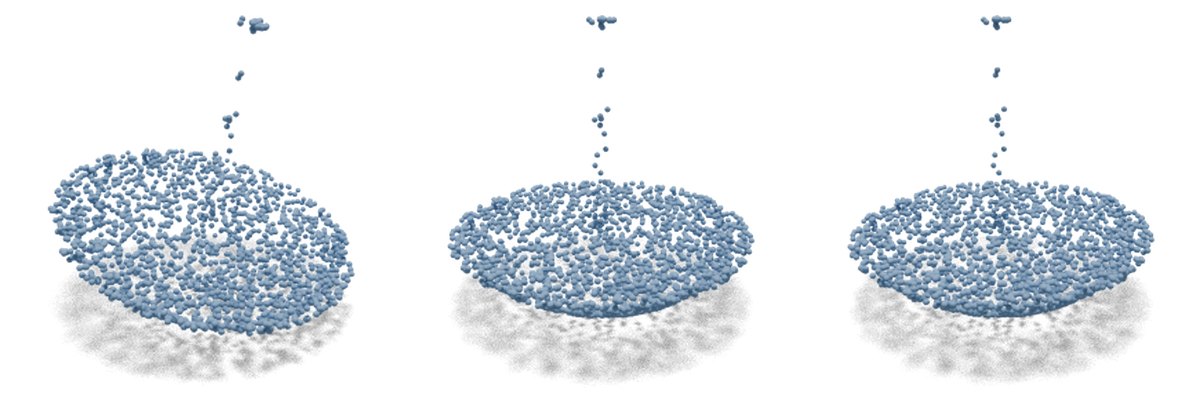
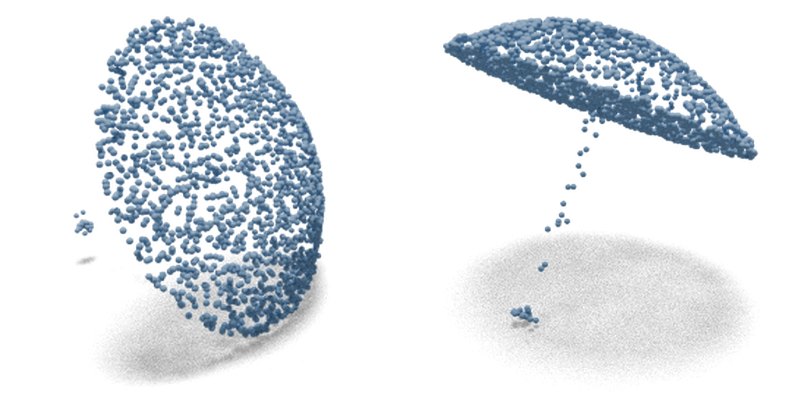
Drag the point cloud to rotate the input by R: every mode g of the orbit target, and of DORE's prediction, moves to R·g. When you release it, DORE's highest mode R* is read off and undone, and the shape returns to one of its canonical poses.
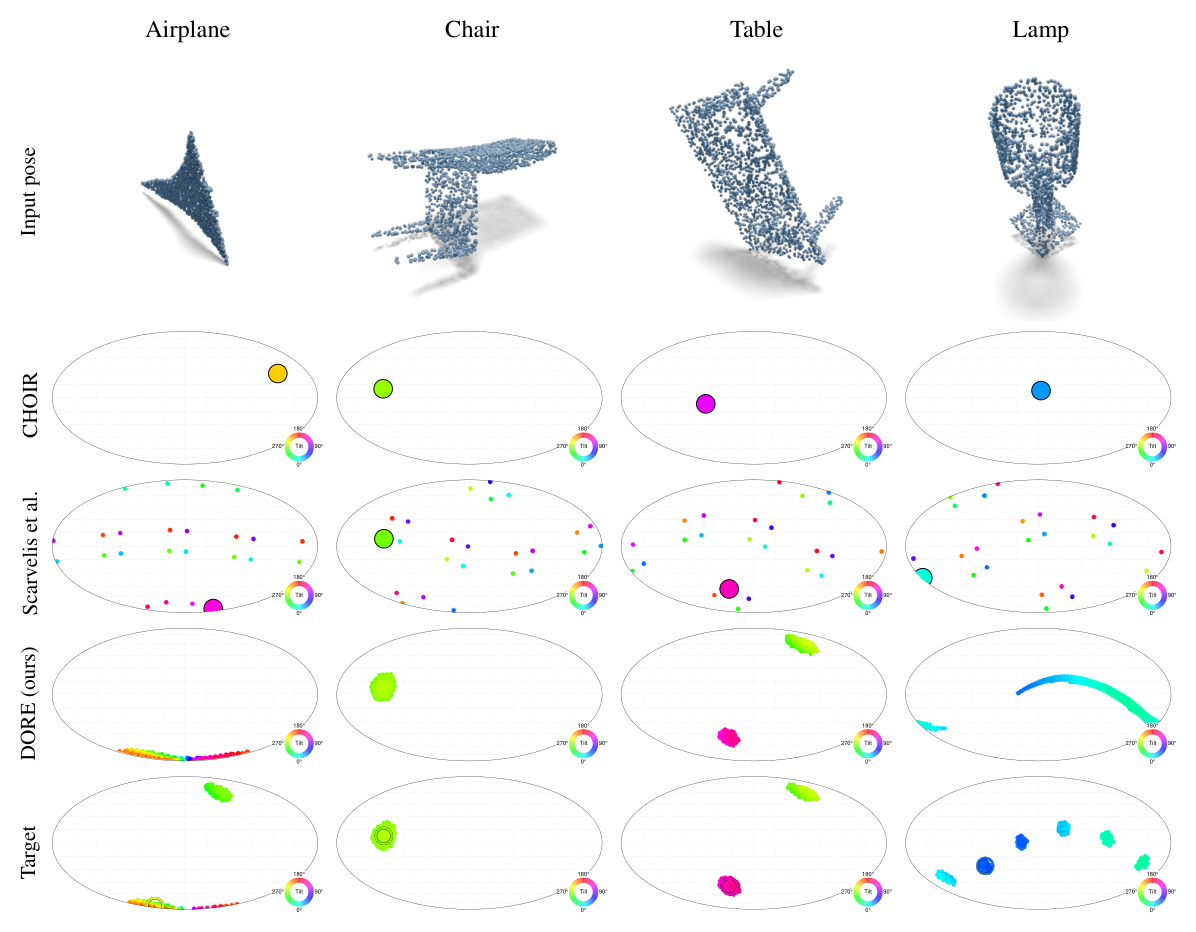
Each dot is a rotation: where it sends the body x-axis, colored by the tilt about it. Rings mark the canonical pose (target) and DORE's highest mode R*.
ShapeNet test-split shapes, chosen so that each prediction shows one mode per element of the shape's symmetry label. The lamp marked ≈SO(2) is the exception on purpose: its shade is round, the labeler's largest cyclic group C6 stands in for that continuous symmetry, and DORE predicts a continuous ring of orientations (the target becomes a ring as well below band 6). Predictions come from the paper's single-pass models at each category's band Lsym (dot under the band button). Dots are the top 0.1% of each density on a 200k-rotation grid. Both densities are computed once on the canonical input and moved by R on this page: exactly for the target, and through the network's equivariance for the prediction, which agrees with running the network on the rotated input to within 1%.
Results
Benchmark on ShapeNet
With one forward pass, DORE is ahead of the prior state of the art in every category on both metrics: 82.8 mean accuracy against 73.7, without test-time augmentation for either method.
| Method | Mean Chamfer distance (×10−3) ↓ | Accsym@ε (%) ↑ | ||||||||||
|---|---|---|---|---|---|---|---|---|---|---|---|---|
| Airplane | Car | Chair | Table | Lamp | Cellphone | Airplane | Car | Chair | Table | Lamp | Cellphone | |
| CHOIR | 198.1 | 103.0 | 92.3 | 95.5 | 238.7 | 183.2 | 0.0 | 0.0 | 0.0 | 0.0 | 0.0 | 0.0 |
| CHOIR† | 16.4 | 4.6 | 5.8 | 44.3 | 69.5 | 140.1 | 54.2 | 86.6 | 80.8 | 13.1 | 16.0 | 0.5 |
| Scarvelis et al. | 4.6 | 3.4 | 4.3 | 5.5 | 29.5 | 9.1 | 81.9 | 90.1 | 85.5 | 80.5 | 36.9 | 67.6 |
| DORE (ours) | 1.5 | 1.2 | 2.1 | 5.1 | 28.2 | 5.0 | 92.6 | 98.3 | 93.8 | 84.2 | 45.6 | 82.4 |
Table 1 of the paper. One forward pass per input; DORE at Lsym = 2/2/2/4/6/2. CHOIR† uses per-class frame calibration. A prediction is correct when the Chamfer distance of the canonicalized shape is below ε, the error of a 10° rotation of the same shape; any orientation in the symmetry orbit counts. Bold: best; underline: second best.
Test-time scaling
Reading several modes of the density adds best-of-N selection and coefficient averaging: 85.5 at 28.5 ms per shape. The baseline needs 50-vote augmentation, 353.2 ms, to reach 86.0; at DORE's latency (4 votes) it reaches 81.0.
Six-category mean Accsym@ε against wall time per shape at batch size 64 on one RTX 3090, linear axis. Baseline: Scarvelis et al., retrained per category with the authors' code. BoN: best-of-N selection among density modes; CA: coefficient averaging over eight inputs.
Qualitative comparison
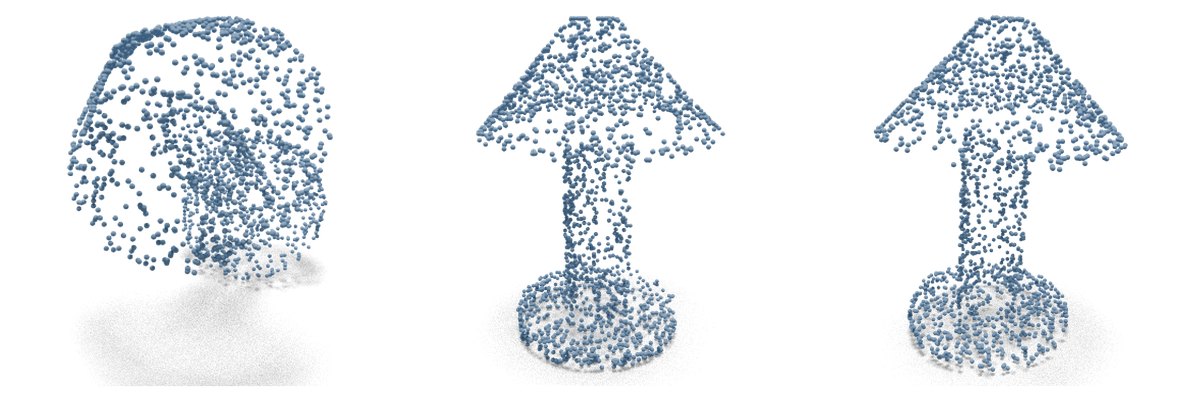
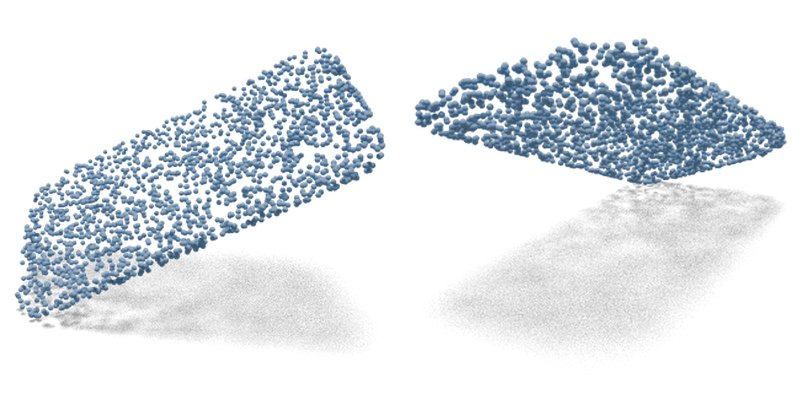
DORE's prediction follows the orbit of the target: a single mode on the chair, two modes for the table's C2 symmetry, and an arc through the six target modes of the nearly round lamp.
Random test samples
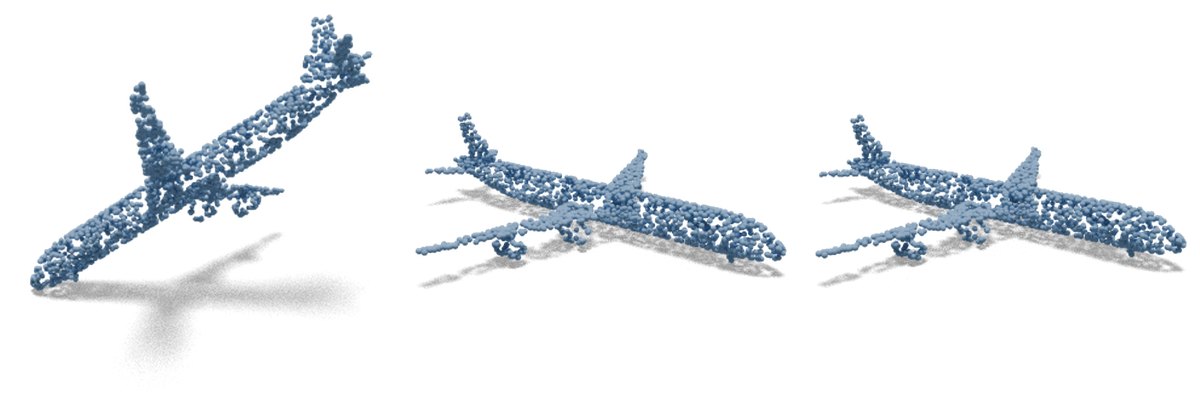
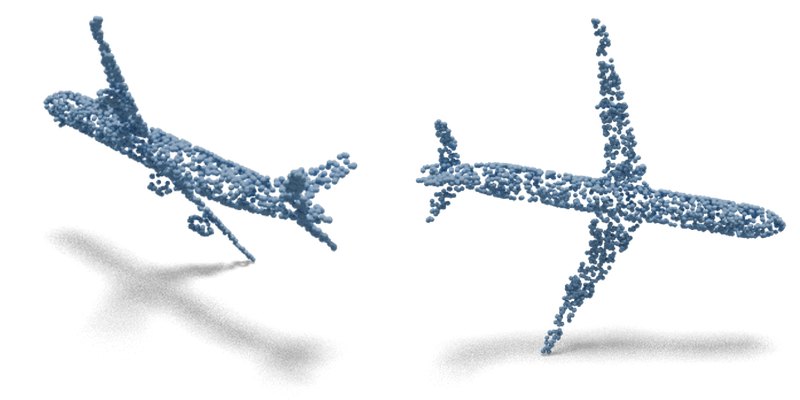
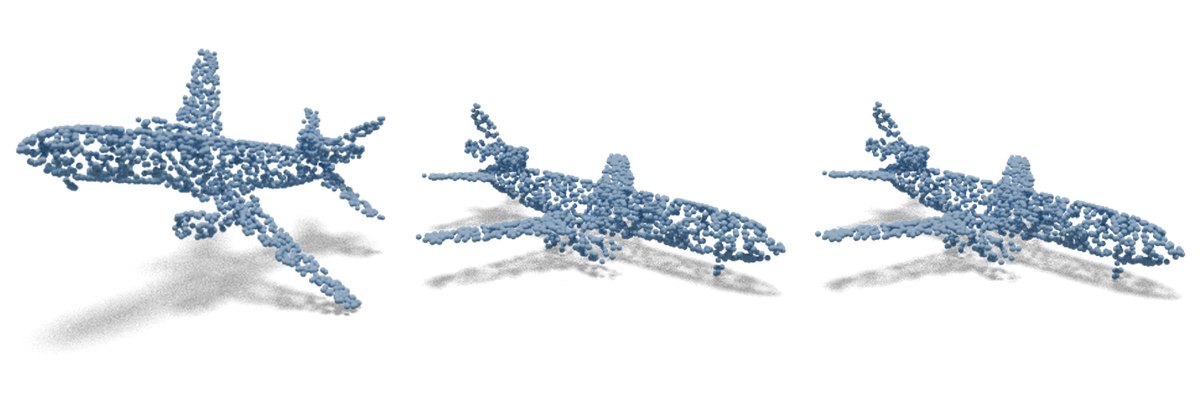
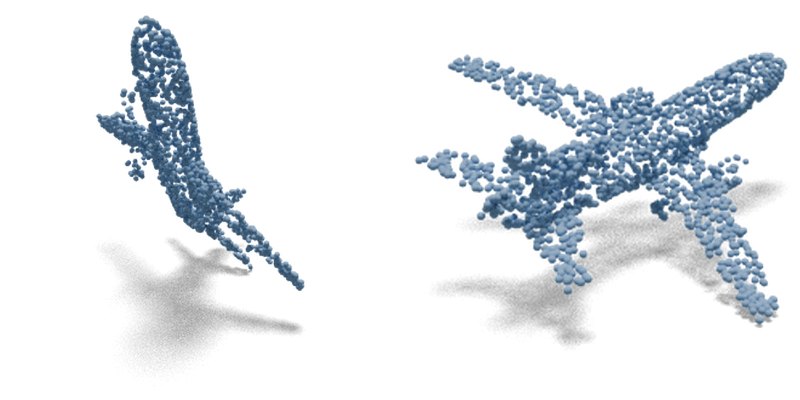
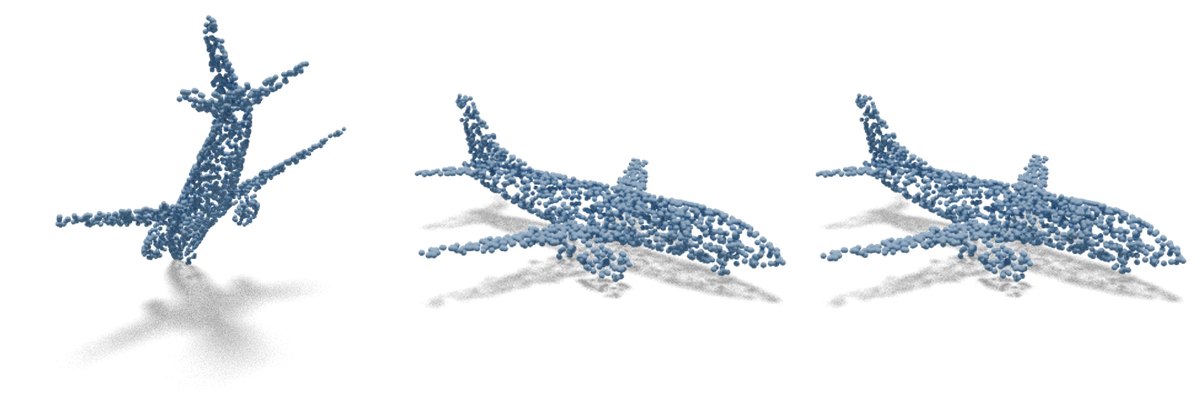
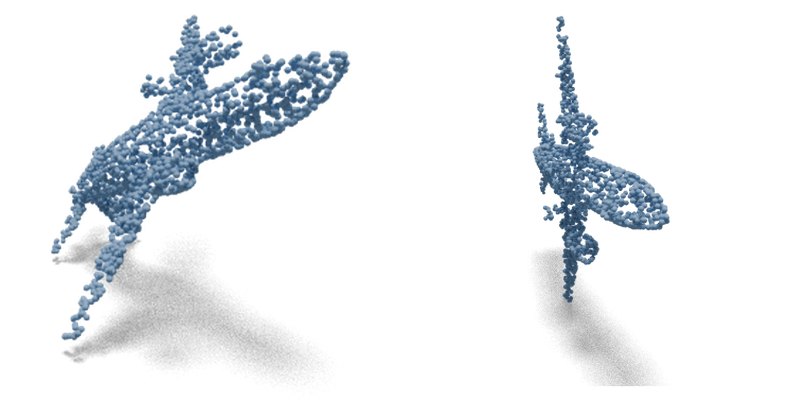
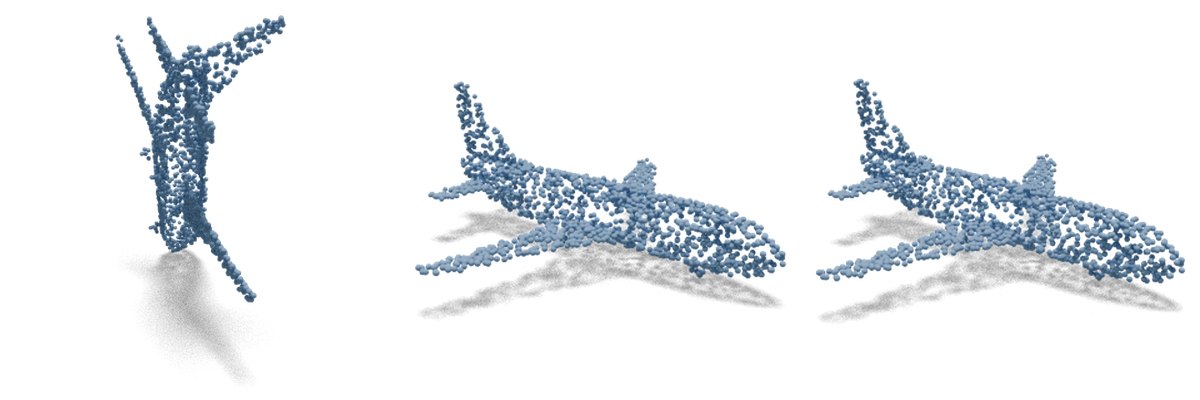
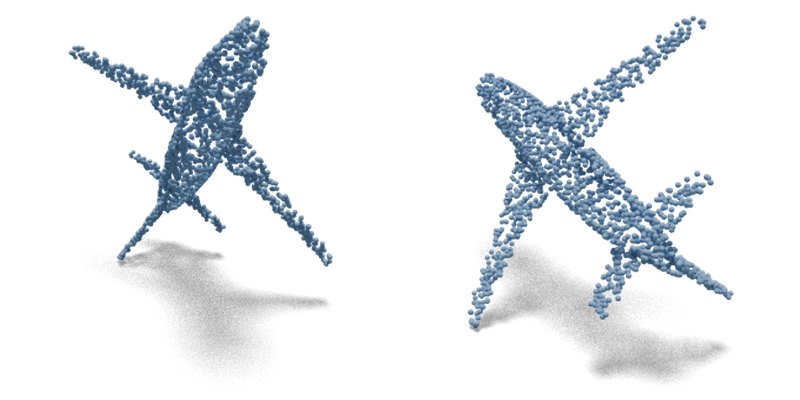
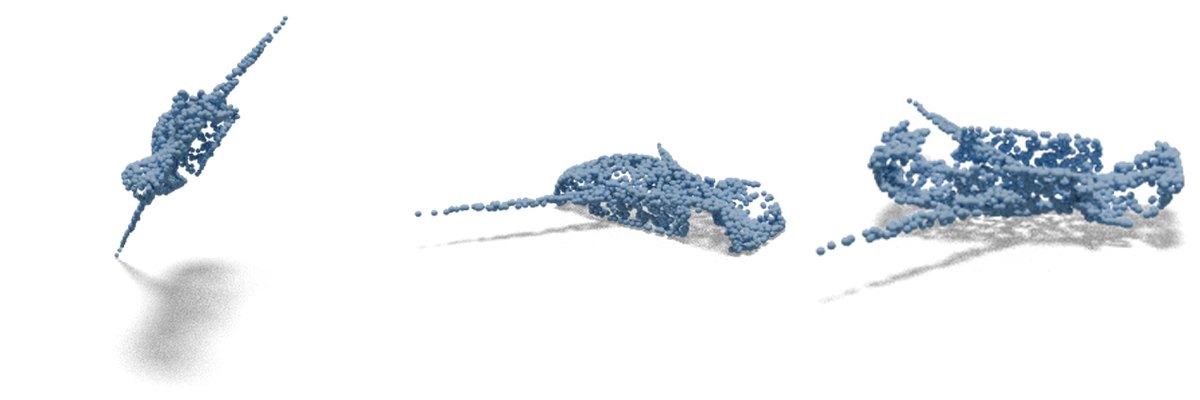
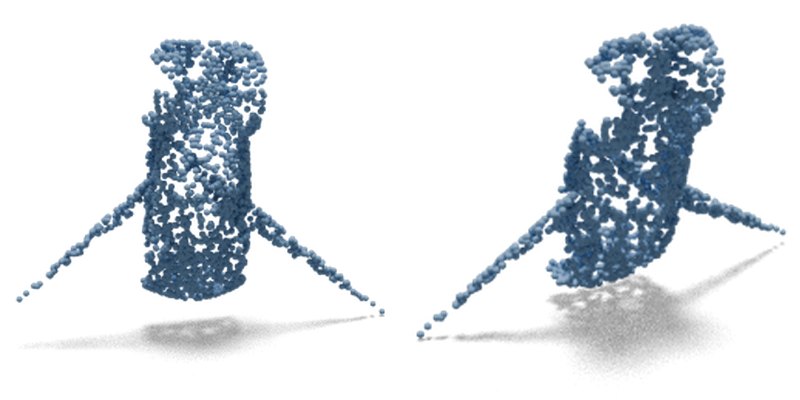
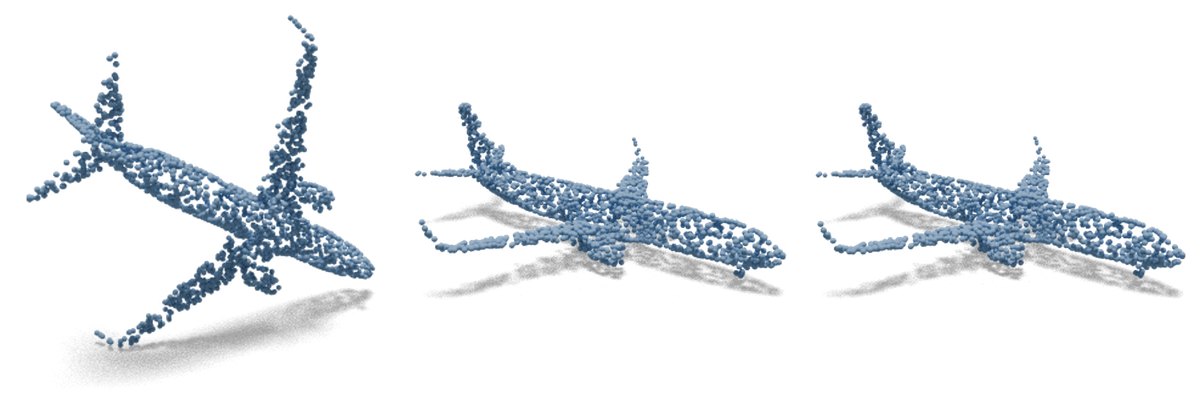
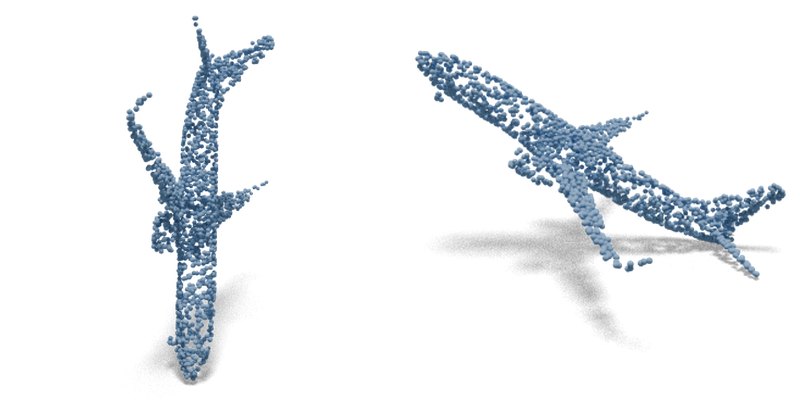
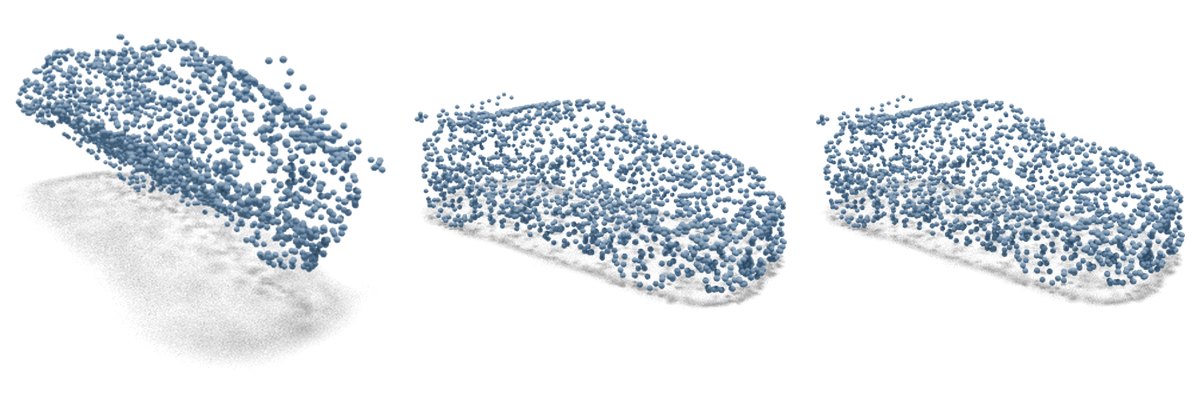
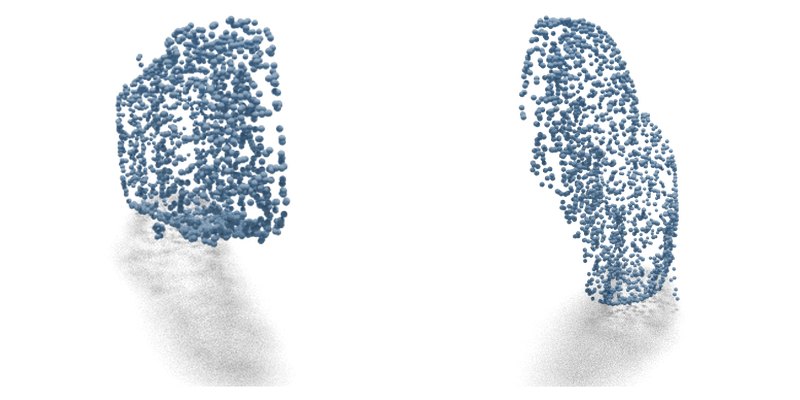
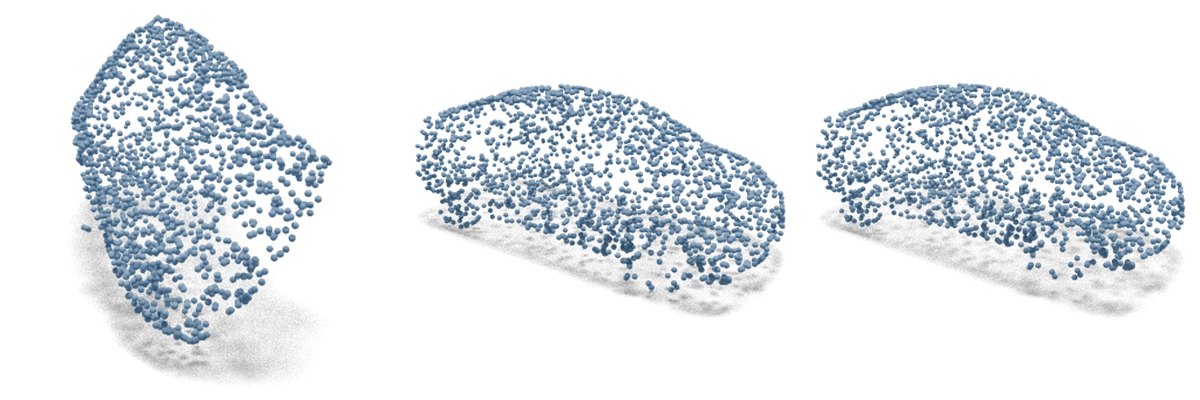
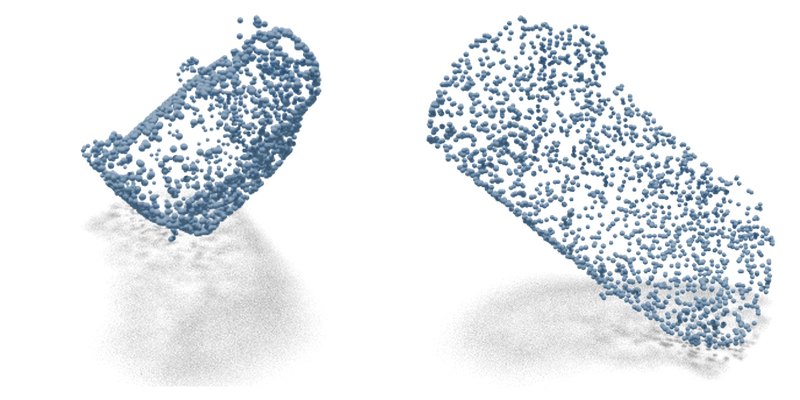
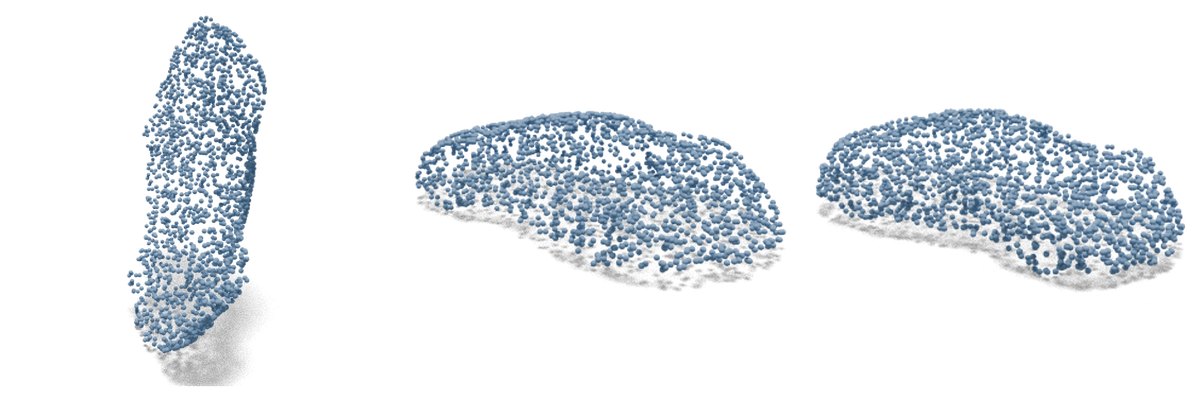
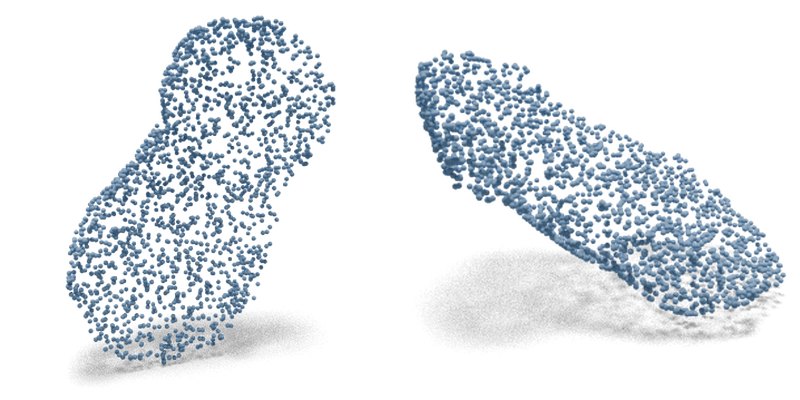
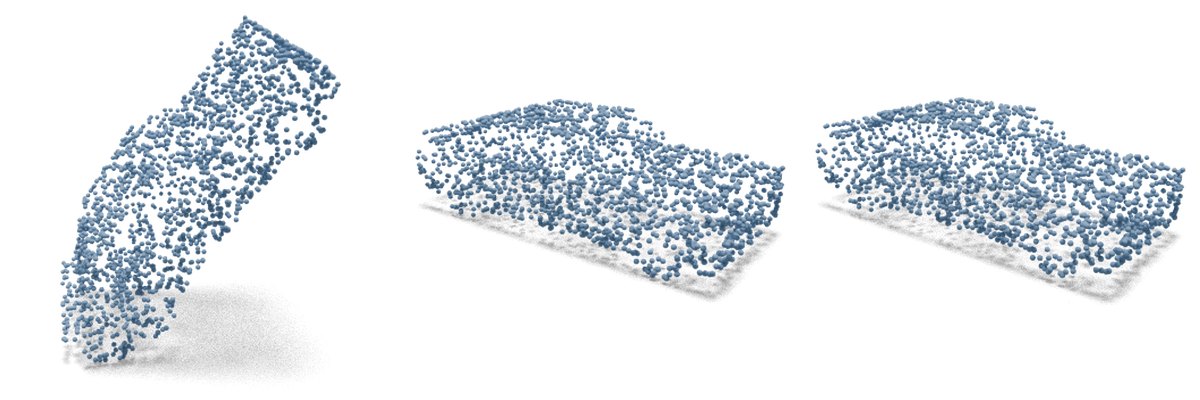
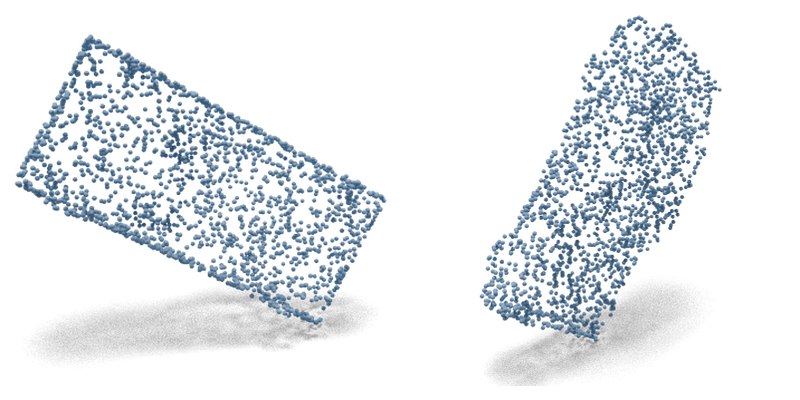
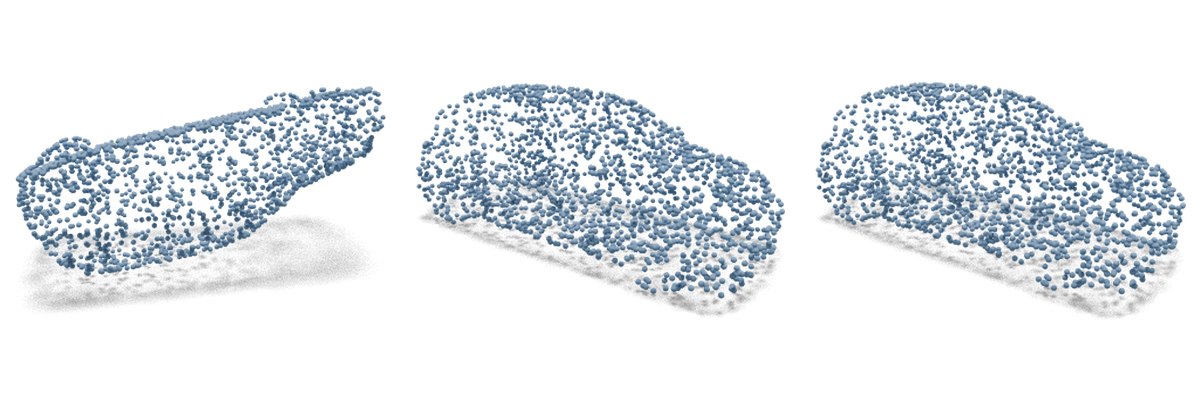
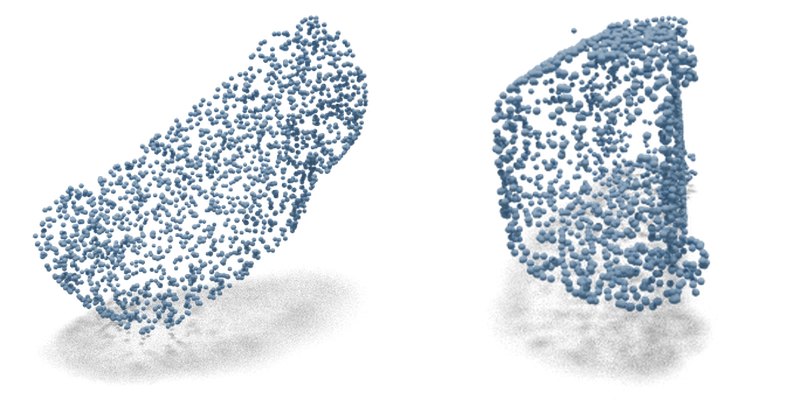
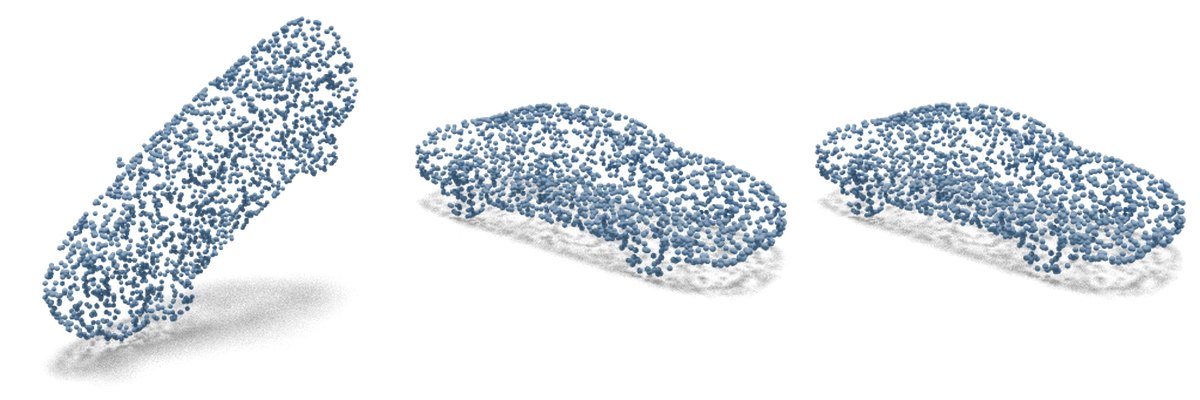
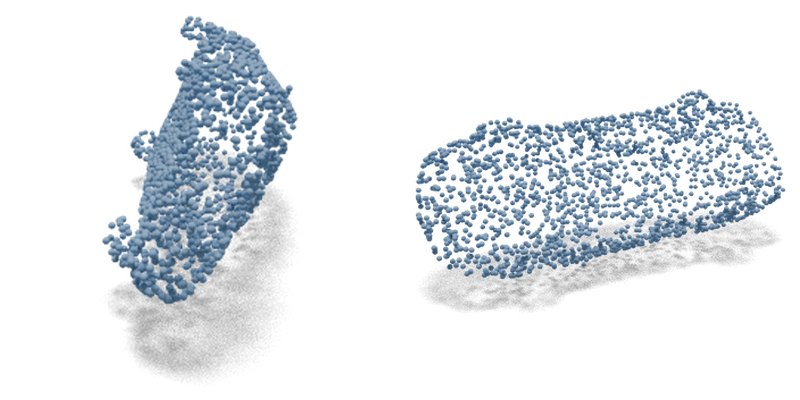
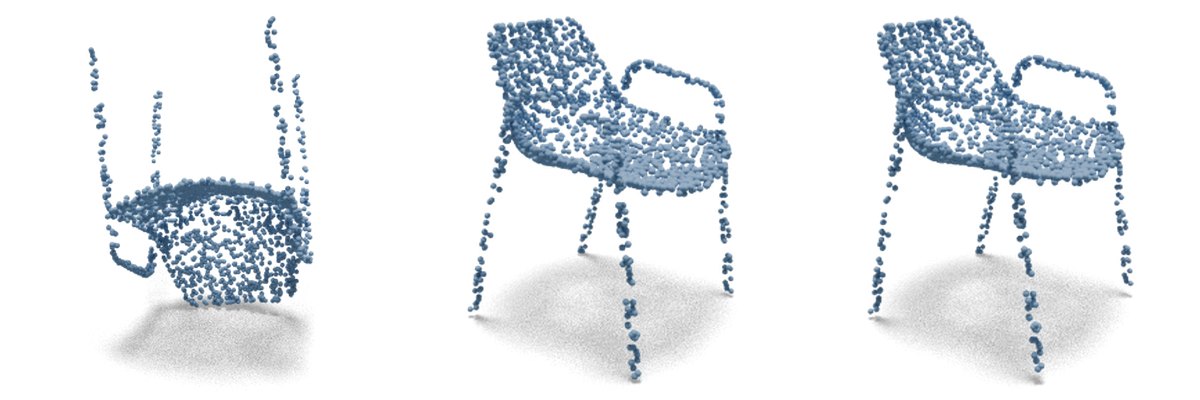
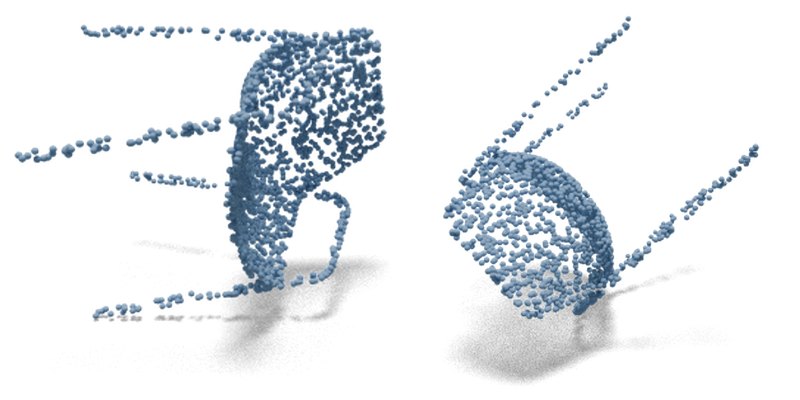
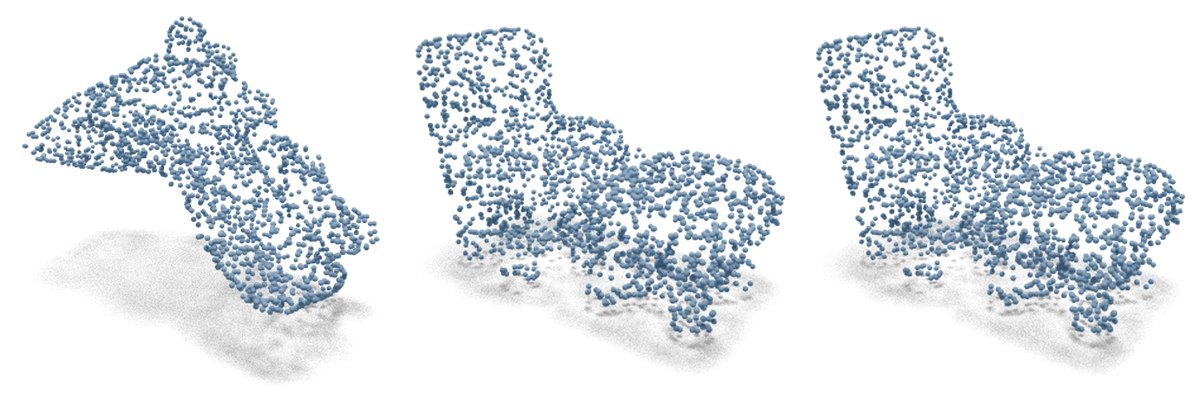
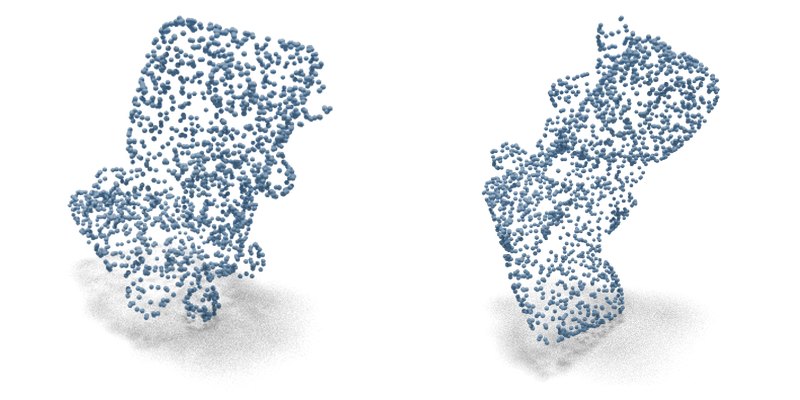
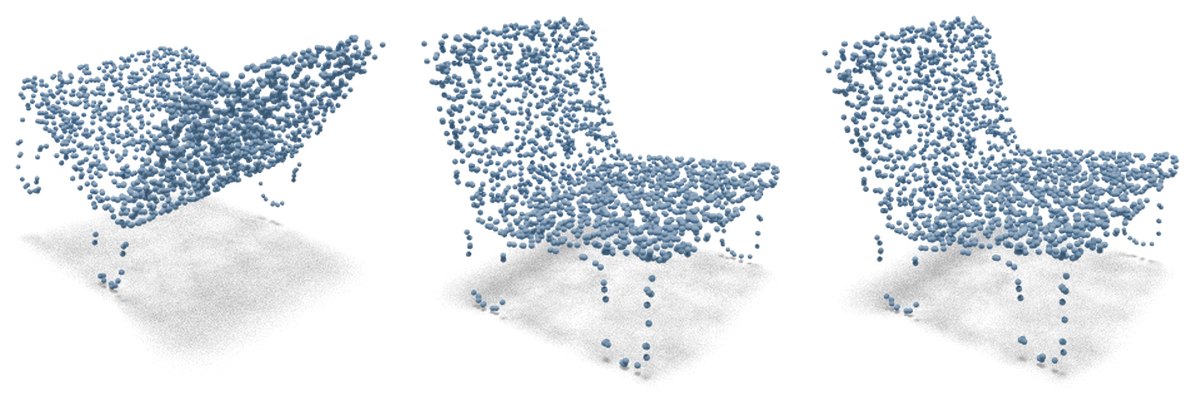
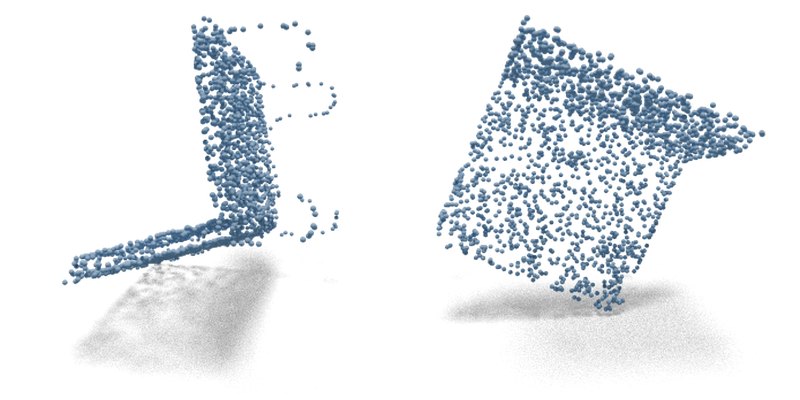
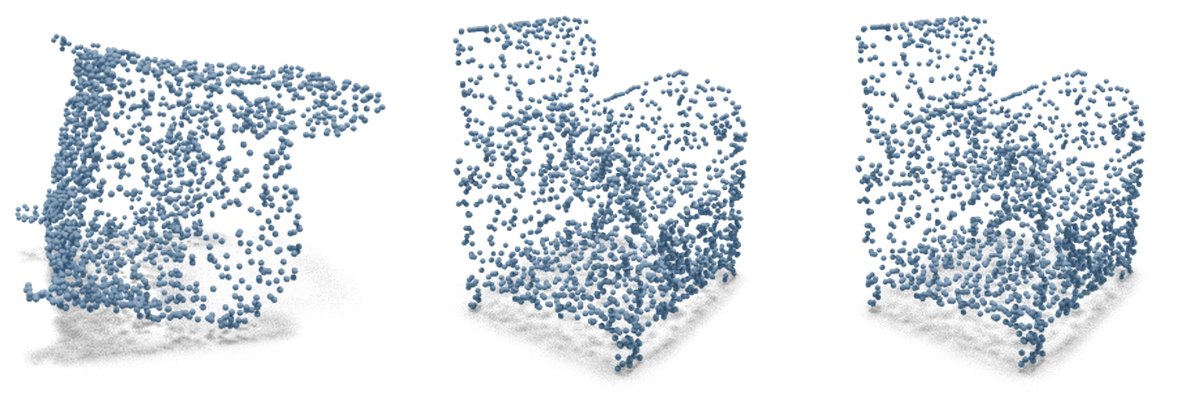
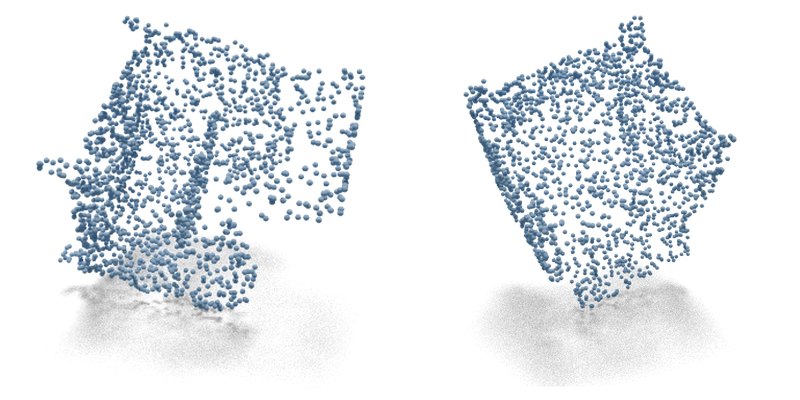
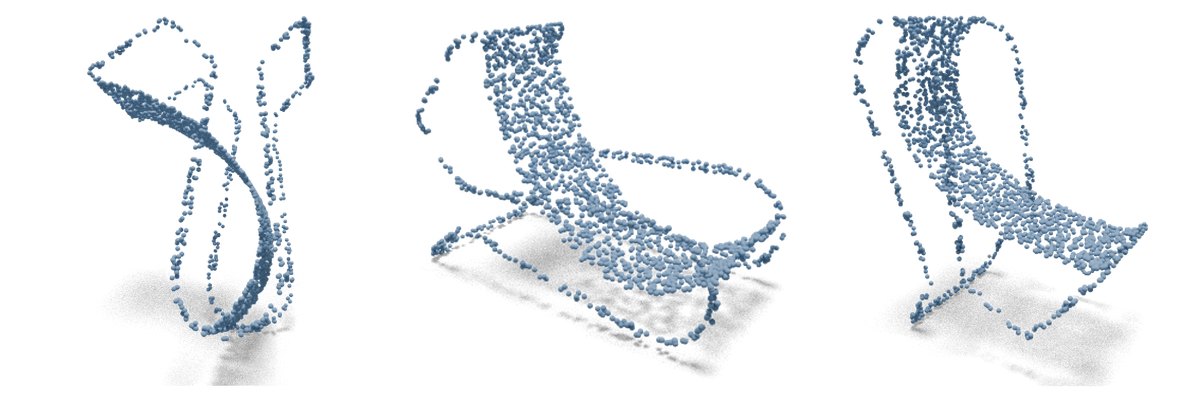
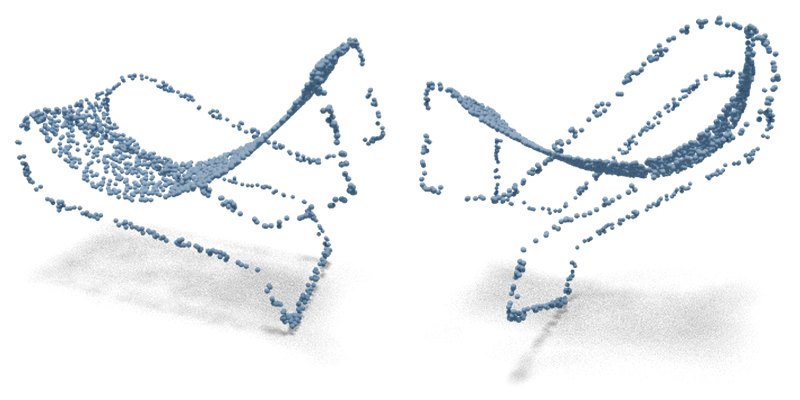
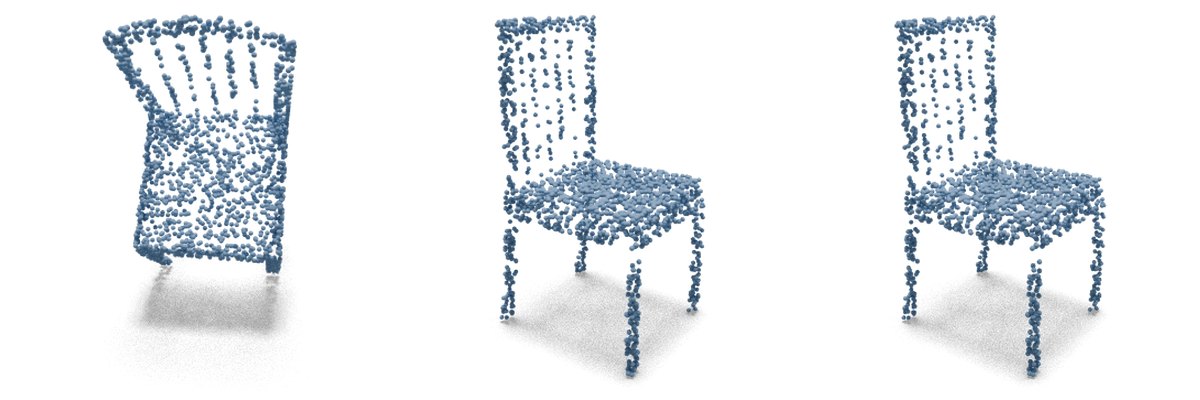
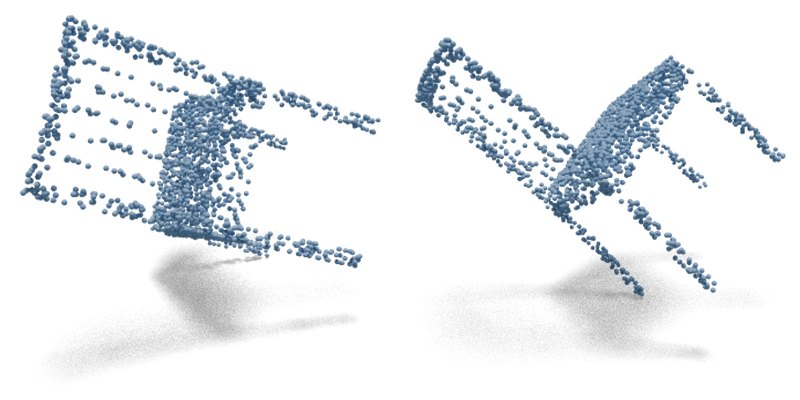
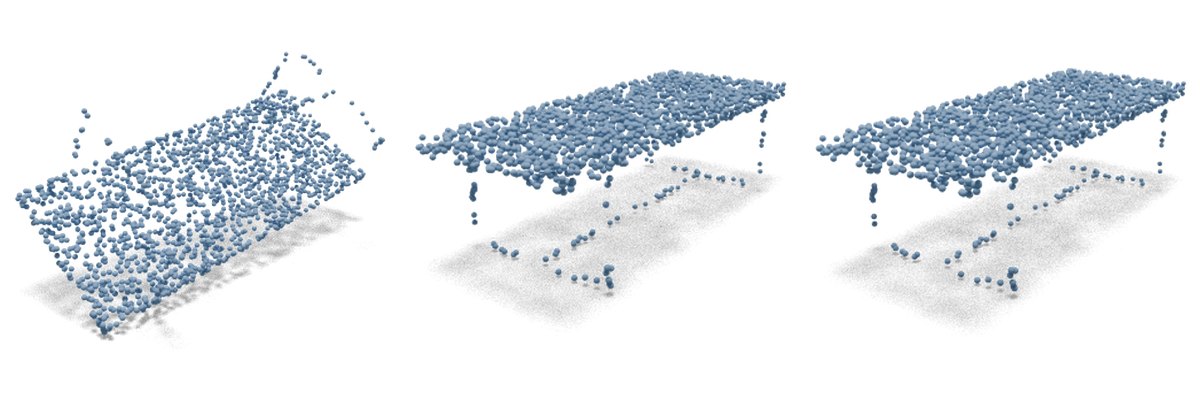
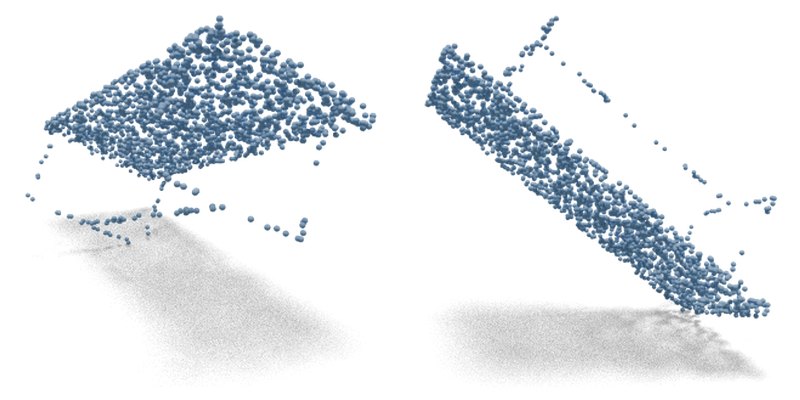
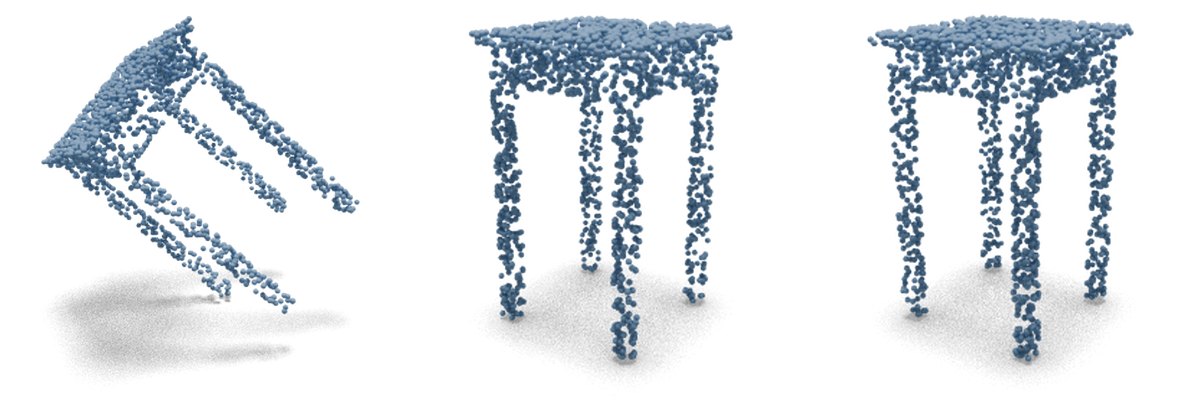
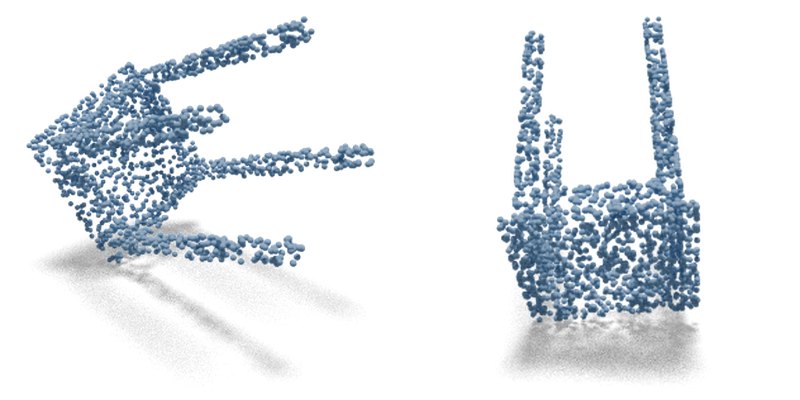
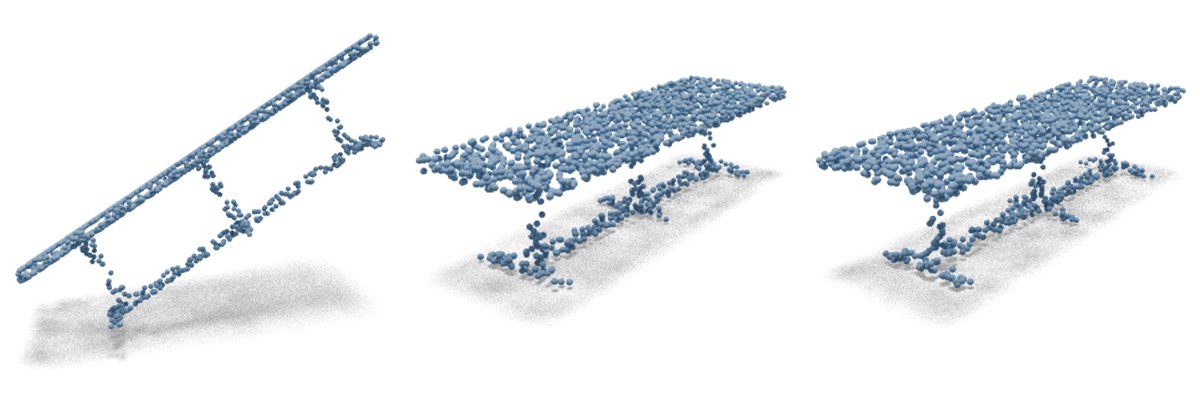
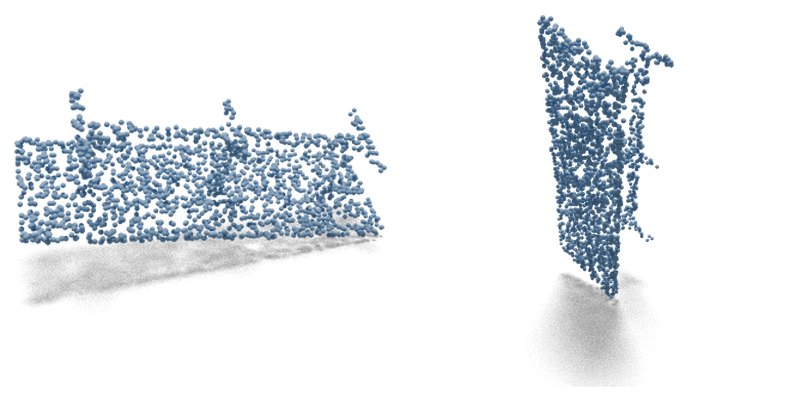
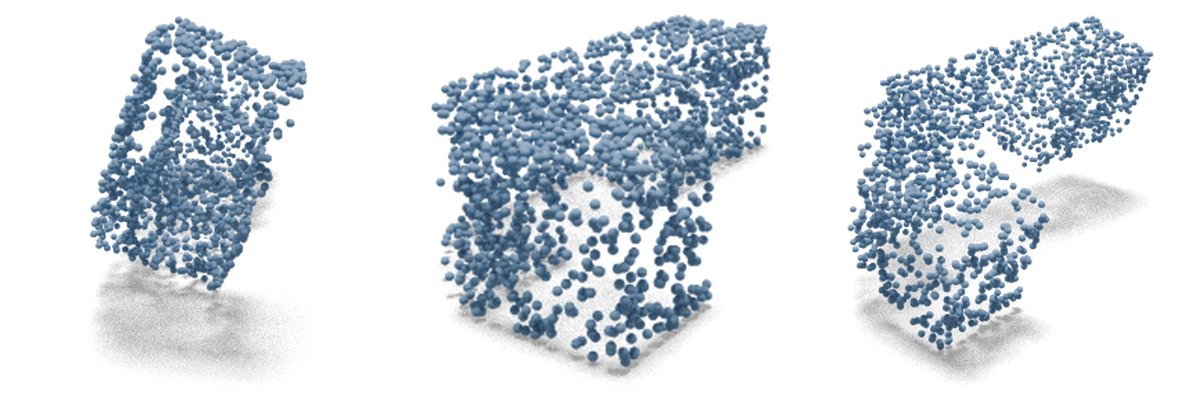
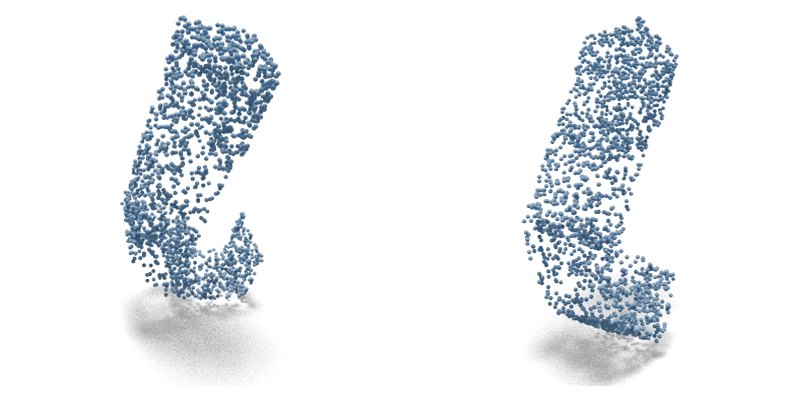
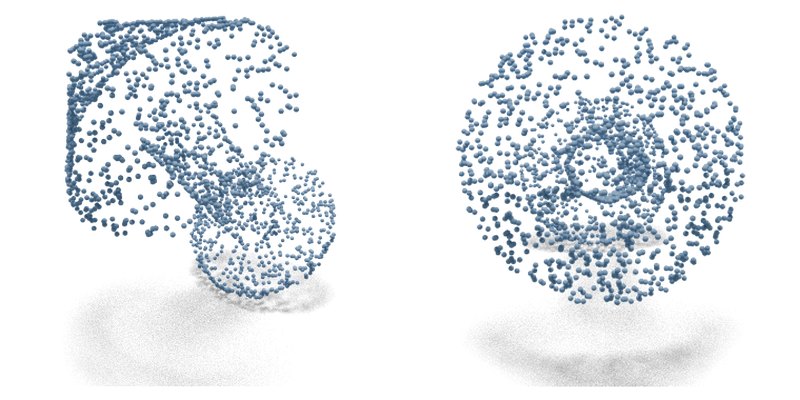
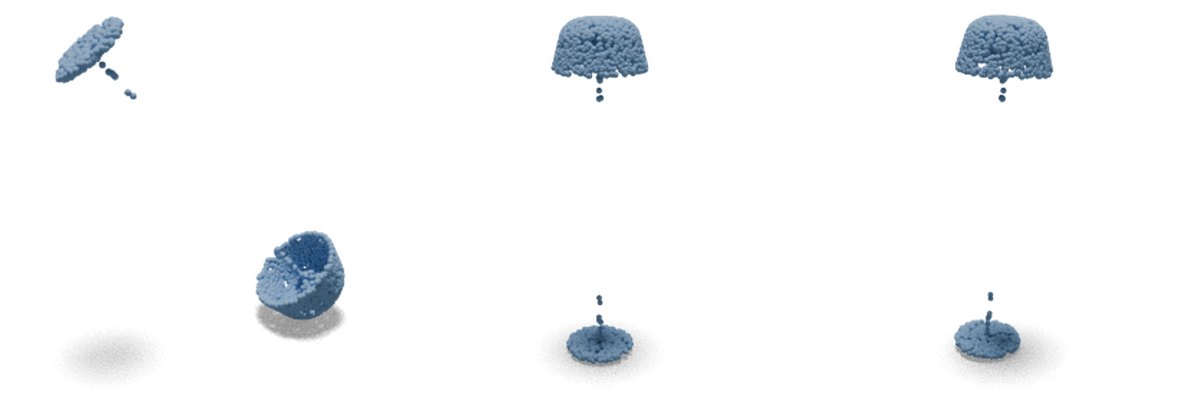
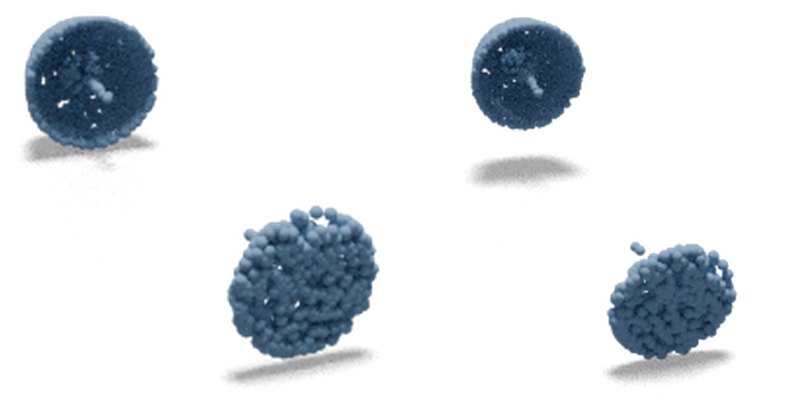
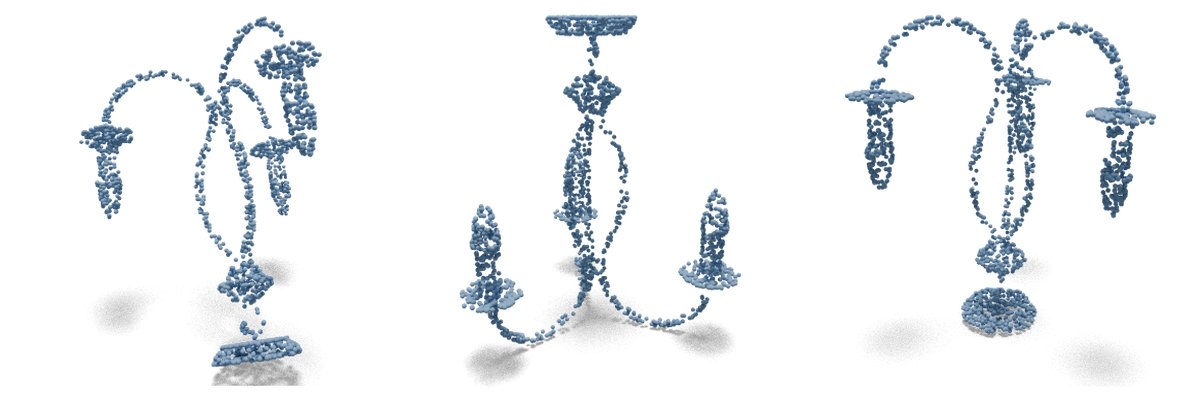
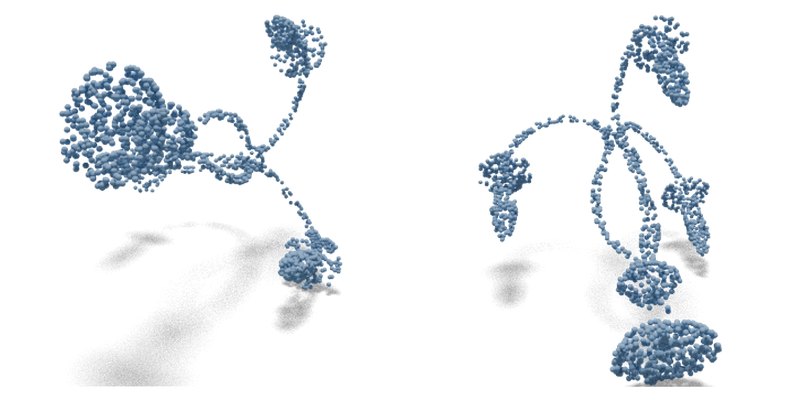
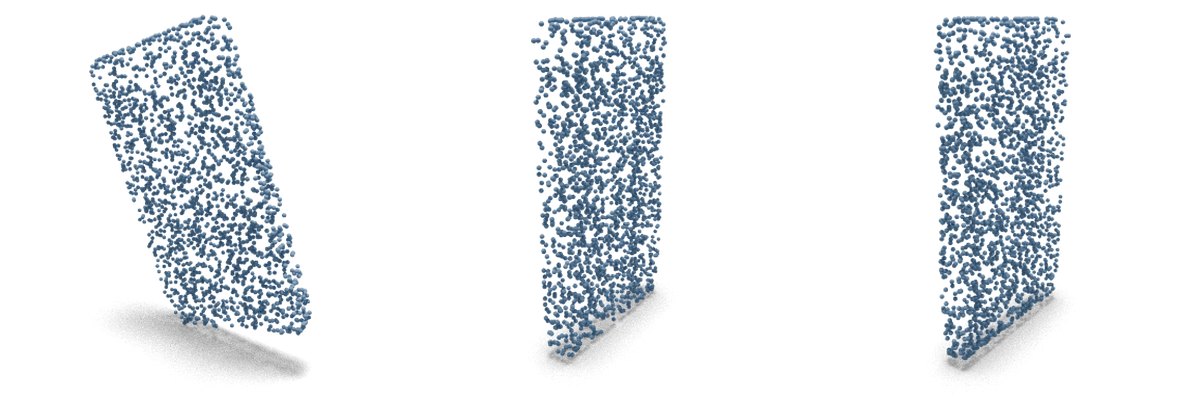
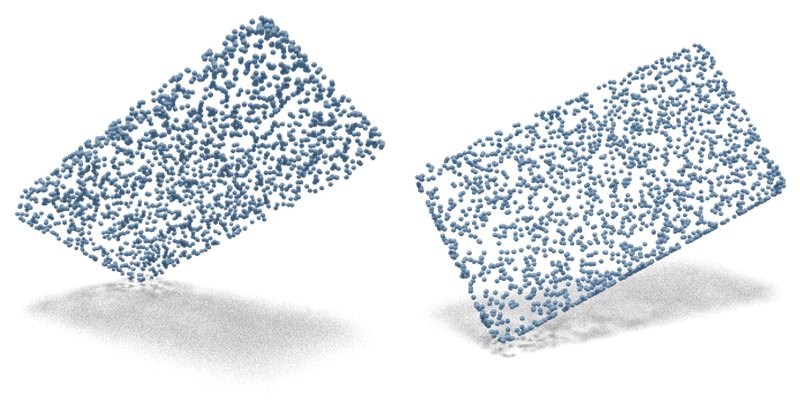
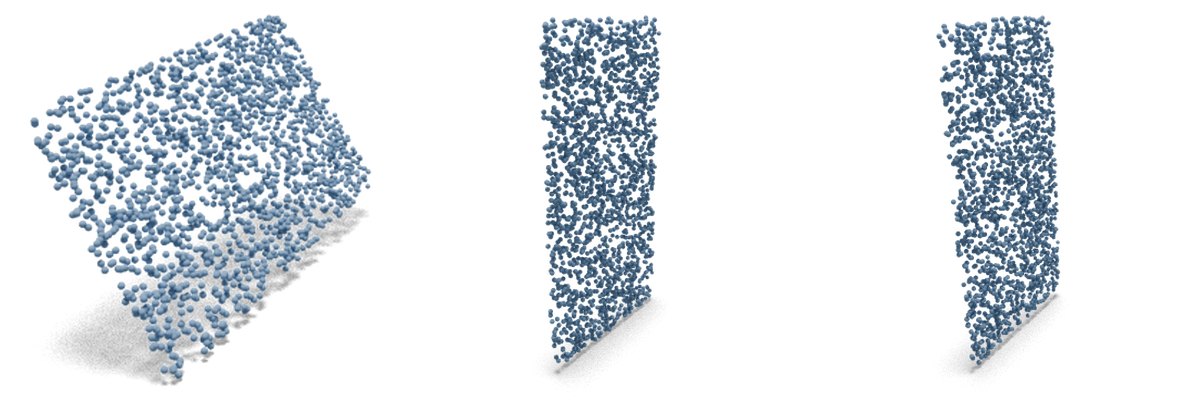
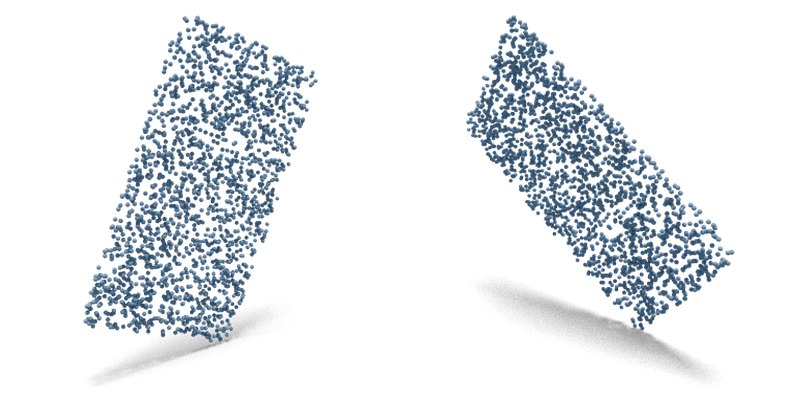
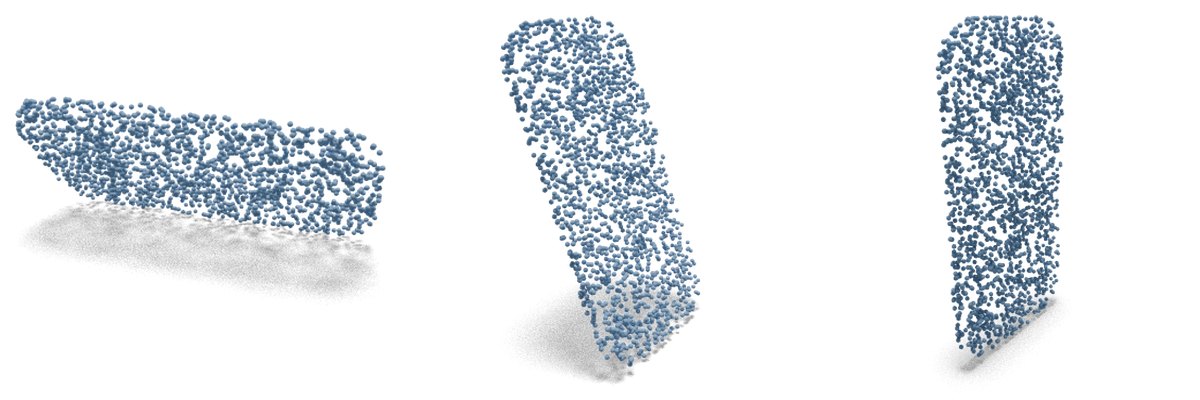
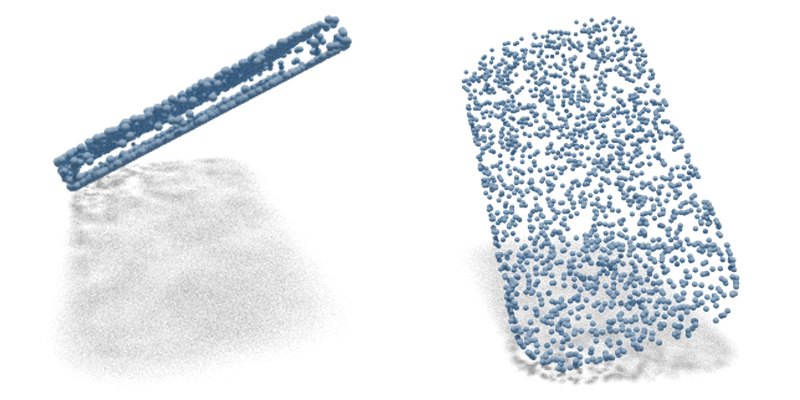
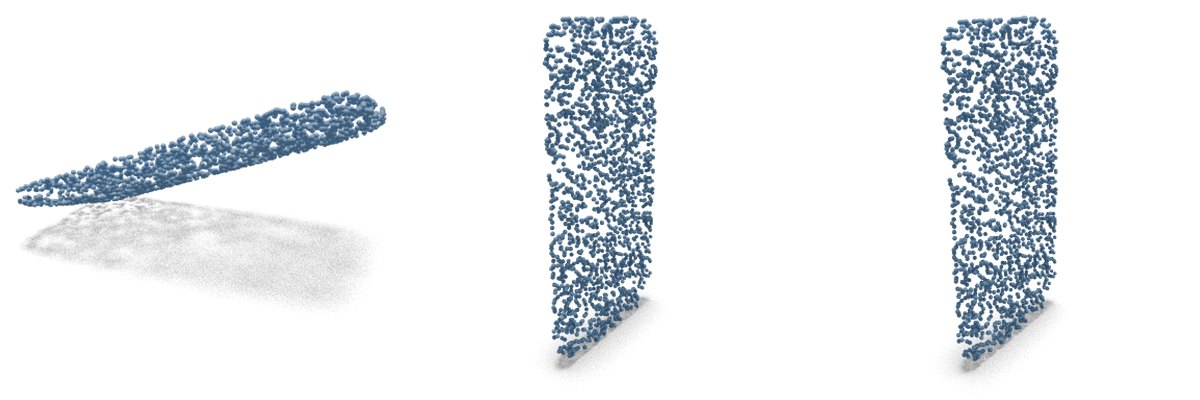
Randomly drawn test inputs, the ground-truth canonical pose (GT), and the pose DORE returns in one forward pass. Failures are drawn in proportion to each category's failure rate, with at least one per category, as in the paper's appendix. For scale, the two dashed tiles show GT turned by a uniformly random rotation at least 30° away from it, scored the same way. Numbers are the Chamfer distance to GT in units of the per-object threshold ε, the error of a 10° rotation of the shape; at most 1ε counts as correct. A symmetric shape may come back in another valid orientation than GT and still be correct.
Theory
DORE is built on the representation theory of SO(3). Five results carry the method, each stated and proved in the paper's appendix.
-
1
A density on SO(3) is a stack of matrix blocks
Peter–Weyl theorem · Appendix A.1
\[ L^2(SO(3)) \;\cong\; \widehat{\bigoplus_{\ell\ge 0}}\, \operatorname{End}(V^\ell), \qquad f(R)=\sum_{\ell\ge 0}(2\ell+1)\,\operatorname{tr}\!\big(H^\ell D^\ell(R)^{\top}\big), \qquad H^\ell=\int_{SO(3)} f(R)\,D^\ell(R)\,\mathrm{d}R \]The Wigner-D matrices \(D^\ell\) of the irreducible representations \(V^\ell\), of dimension \(2\ell+1\), form an orthogonal basis of \(L^2(SO(3))\), and the Plancherel identity \(\|f\|^2=\sum_\ell (2\ell+1)\|H^\ell\|_F^2\) turns distances between densities into distances between coefficients. DORE outputs the blocks up to a band \(L_{\max}\): \(\sum_{\ell\le L_{\max}}(2\ell+1)^2\) numbers, which is 35, 165 and 455 at \(L_{\max}=2, 4, 6\).
-
2
Equivariance is one linear rule per block
Coefficient condition for equivariance · Appendices A.2 and A.3
\[ h(\mathbf{P}R)(S)=h(\mathbf{P})(SR^{-1}) \;\;\text{for all } S \quad\Longleftrightarrow\quad \hat{H}^\ell(\mathbf{P}R)=\hat{H}^\ell(\mathbf{P})\,D^\ell(R) \;\;\text{for all } \ell \]Rotating the input moves every mode of the predicted density with it exactly when each block is multiplied on the right by \(D^\ell(R)\). The spectral head meets this rule by construction: the spherical-harmonic lift satisfies \(Y^\ell(Rv)=D^\ell(R)\,Y^\ell(v)\), the linear layers mix only channels while \(D^\ell(R)\) acts only on the irrep index, so the two commute. Inference therefore needs no rotation augmentation.
-
3
A symmetry group is a projector
Group identification lemma · Appendices A.1 and B.3
\[ F^\ell_G=\frac{1}{|G|}\sum_{g\in G} D^\ell(g), \qquad (F^\ell_G)^2=F^\ell_G=(F^\ell_G)^{\top}, \qquad \operatorname{tr}F^\ell_G=m_\ell(G), \qquad H^{*\ell}=\kappa_\ell\,F^\ell_G \]Averaging \(D^\ell\) over a group \(G\le SO(3)\), with a Haar average when \(G\) is continuous, gives the orthogonal projector onto the \(G\)-invariant vectors of \(V^\ell\), and its trace counts them. The training target of a shape with symmetry \(G\) is exactly these projectors, damped by a heat kernel, \(\kappa_\ell=e^{-\ell(\ell+1)\sigma^2}\), so \(\|H^{*\ell}\|_F\le\sqrt{2\ell+1}\,\kappa_\ell\). Densities invariant under \(G\) are densities on the coset space, \(L^2(SO(3))^G\cong L^2(G\backslash SO(3))\): one output space holds the quotient for every \(G\), with no group fixed in advance.
-
4
An \(n\)-fold symmetry first appears at degree \(n\)
First expressible degree · Appendix A.1
\[ m_\ell(C_n)=1+2\Big\lfloor \frac{\ell}{n}\Big\rfloor, \qquad m_\ell(D_n)=\Big\lfloor \frac{\ell}{n}\Big\rfloor+\mathbf{1}[\ell\ \text{even}], \qquad L<n \;\Rightarrow\; f^{C_n}_L=f^{SO(2)}_L,\;\; f^{D_n}_L=f^{O(2)}_L \]With the axis along \(z\), a degree-\(\ell\) vector is \(C_n\)-invariant exactly when its azimuthal index \(m\) satisfies \(n\mid m\). Below degree \(n\) only \(m=0\) survives, so a band-limited \(n\)-fold orbit cannot be told apart from the continuous ridge of \(SO(2)\) or \(O(2)\); at degree \(n\) its \(n\) modes separate. The polyhedral groups \(T\), \(O\), \(I\) first appear at degrees 3, 4 and 6. This is how DORE sets the band of each category, \(L_{\mathrm{sym}}\), from the symmetry labels alone.
 C4 table
 ℓ ≤ 1ridge
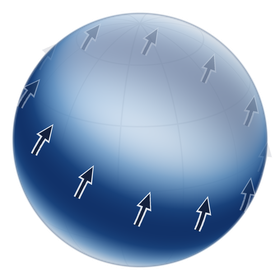 ℓ ≤ 2ridge
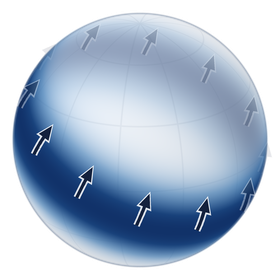 ℓ ≤ 3ridge
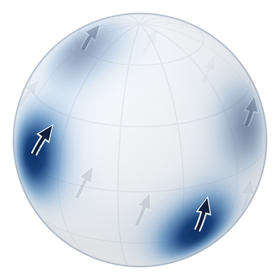 ℓ ≤ 44 modes
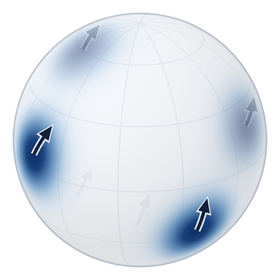 ℓ ≤ 5sharper
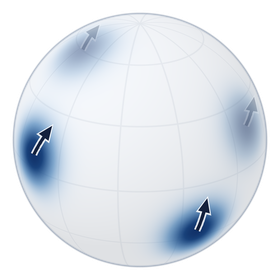 ℓ ≤ 6sharper
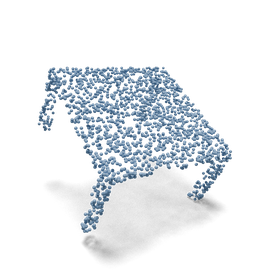
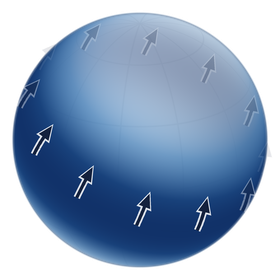
The orbit target of a table with a four-fold symmetry, kept up to degree ℓ. Each arrow is one orientation of the table. -
5
The loss is a Sobolev distance
Casimir spectrum and Sobolev weights · Appendix C.1
\[ \Delta D^\ell_{ij}=-\ell(\ell+1)\,D^\ell_{ij}, \qquad w_\ell=\ell(\ell+1) \;\Rightarrow\; Z\,\mathcal{L}_{\mathrm{sup}} \;\asymp\; \|\hat{h}-h^*\|^2_{H^{-1/2}(SO(3))}, \qquad w_\ell=\lambda_\ell^{\,k} \;\leftrightarrow\; s=k-\tfrac{3}{2} \]The Laplace–Beltrami operator acts on degree \(\ell\) by the Casimir eigenvalue \(-\ell(\ell+1)\). Weighting each block error by \(w_\ell=\ell(\ell+1)\), averaged over its \((2\ell+1)^2\) entries, makes the training objective equivalent, up to constants, to the squared \(H^{-1/2}\) Sobolev distance between band-limited densities of equal mass; weights \(\lambda_\ell^k\) give \(H^{k-3/2}\). A negative order compares smoothed densities, which matches the heat-kernel targets.
BibTeX
@inproceedings{kim2026dore,
  title     = {Distributional Estimation of 3D Object Orientation},
  author    = {Kim, Minjoon and Park, Chunghyun and Cho, Minsu},
  booktitle = {Advances in Neural Information Processing Systems (NeurIPS)},
  year      = {2026}
}